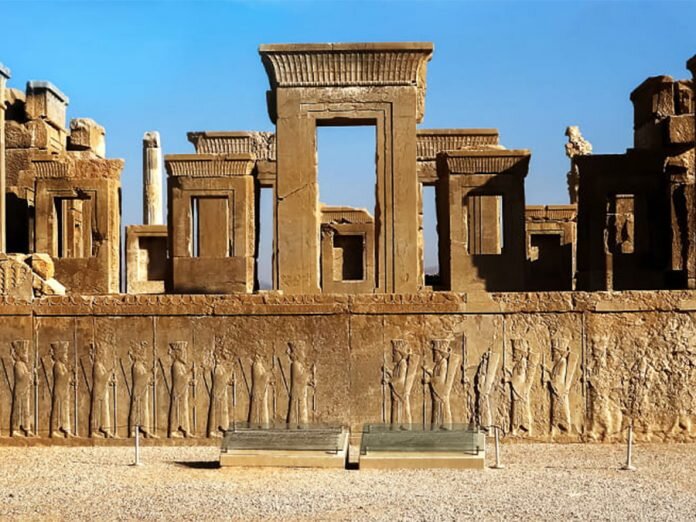
Persepolis: A New Perspective on Its Architecture, Power, and Hidden Secrets
Abstract
Persepolis, the ceremonial capital of the Achaemenid Empire, stands as one of the most remarkable architectural achievements of the ancient world. Beyond its grandeur, it served as a highly organized administrative center, a visual diplomatic tool, and a sophisticated economic hub. This article explores Persepolis from a fresh perspective, analyzing its modular urban planning, visual diplomacy, and advanced financial system. Additionally, recent archaeological discoveries and modern challenges in preserving this UNESCO World Heritage site are examined.
1. Introduction
Persepolis, located in modern-day Iran, was commissioned by Darius the Great in 518 BCE as a testament to the power and unity of the Achaemenid Empire (Schmidt, 1953). This architectural marvel was not merely a royal residence but a meticulously planned complex reflecting the empire’s governance, economic management, and cultural diversity (Root, 1979).
In this analysis, we investigate Persepolis as an administrative powerhouse, a propaganda instrument carved in stone, and an architectural wonder that employed modular and resilient design principles.
2. Persepolis as an Administrative and Diplomatic Center
2.1. A Centralized Economic and Administrative Hub
The discovery of Elamite clay tablets at Persepolis has provided unparalleled insights into the empire’s bureaucratic system. These records document wages, rations, and workforce management, revealing a decentralized yet highly organized financial structure (Hallock, 1969).
• Wages Based on Skill, Not Social Class – Workers were paid according to their expertise and seniority, not merely their societal status.
• Regional Resource Allocation – Taxes were collected at a provincial level and reinvested regionally, a rare practice in ancient empires (Briant, 2002).
2.2. Visual Diplomacy in Persepolis
The reliefs on the staircases and walls of the palaces were not mere decorations; they served as a universal visual language for diplomacy (Root, 1979).
• Unity in Diversity – Depictions of 23 nations paying tribute to the Persian king convey a subtle yet powerful message: cultural identity was respected under Persian rule.
• Psychological Control through Architecture – The gently sloping staircases forced visitors to ascend slowly, heightening their sense of reverence and submission to the empire’s power (Dusinberre, 2013).
3. Architectural Innovations: A Sustainable and Modular City
3.1. Strategic Location: Military and Climatic Considerations
Unlike low-lying capitals like Susa or Babylon, Persepolis was constructed on an elevated platform, offering both security and climatic stability (Tilia, 1978).
• Resilient Stonework – Local limestone reduced erosion and ensured the longevity of the structures.
• Environmental Adaptation – The site’s elevation minimized the impact of seasonal flooding and humidity.
3.2. Modular Urban Design
Unlike many ancient cities, Persepolis was designed with a modular structure to prevent total system failure in case of damage.
• Independent Functional Areas – Palaces, treasury buildings, and administrative offices operated as autonomous units.
• Underground Passageways – Hidden corridors allowed for secure movement of officials and resources (Tilia, 1972).
4. Recent Archaeological Findings and Preservation Challenges
4.1. Was There a Mosque in Persepolis?
Recent excavations uncovered remnants of a post-Achaemenid structure, possibly repurposed as a mosque during the Islamic period. This challenges the belief that Persepolis was completely abandoned after Alexander’s conquest (Abdi, 2001).
4.2. A More Sophisticated Accounting System
Newly discovered tablets suggest that the Achaemenids maintained a highly detailed financial system, even documenting wages for both men and women separately (Briant, 2002).
4.3. Modern Threats to Persepolis
Today, Persepolis faces several critical threats:
• Erosion due to climate change
• Vegetation growth in structural cracks
• Unregulated tourism damaging reliefs and inscriptions
5. Conclusion
Persepolis was far more than a ceremonial capital; it was a governance model, an economic powerhouse, and a visual propaganda masterpiece. Modern technology, including 3D modeling and AI-based analysis, is helping uncover new aspects of this ancient city.
To ensure its survival, conservation strategies must include digital monitoring and nanotechnology-based stone preservation. As research continues, Persepolis may yet reveal more of its long-hidden secrets.
References
• Abdi, K. (2001). “Persepolis and its Afterlife.” Iranian Journal of Archaeology.
• Briant, P. (2002). From Cyrus to Alexander: A History of the Persian Empire.
• Dusinberre, E. R. (2013). Empire, Authority, and Autonomy in Achaemenid Anatolia.
• Hallock, R. T. (1969). Persepolis Fortification Tablets.
• Root, M. C. (1979). The King and Kingship in Achaemenid Art.
• Schmidt, E. F. (1953). Persepolis I.
• Tilia, A. B. (1972, 1978). Studies and Restorations at Persepolis.
Farzad Jalali Mosallam
JUN-2025
دیدگاهها
هیچ نظری هنوز ثبت نشده است.